
Notes from a numbers geek
Track & Field highlights from the past week

I am a numbers geek.
Whether the topic is sports, science, the economy, or some other subject, statistics can tell you a lot.
Therefore, it was interesting to see the different paths the University of Florida women and the University of Texas men took in winning their respective team titles in the NCAA Indoor Track and Field Championships at the Birmingham CrossPlex in Birmingham, Alabama, on March 11 and 12.
Florida, paced by sophomore Jasmine Moore’s victories in the long jump and triple jump, won five of the 17 events in the women’s meet on its way to a 68-56 victory over runner-up Texas that gave the Gators their second indoor team championship, and first since 1992.
Those five victories – which also included wins from freshman Talitha Diggs in the 400, sophomore Grace Stark in the 60 hurdles, and sophomore Anna Hall in the pentathlon – and a second from senior Natricia Hooper in the triple jump, accounted for 58 of the Gators’ points in the meet in which the top eight finishers in each event were awarded points on a 10-8-6-5-4-3-2-1 basis.
While the Florida women scored 58 of their 68 points in speed events—the sprints, hurdles or horizontal jumps, the Texas men tallied their points more broadly, across two middle-distance races, both relays, the shotput and heptathlon, to win their first indoor title with a 47-36 victory over runner-up North Carolina A&T State.
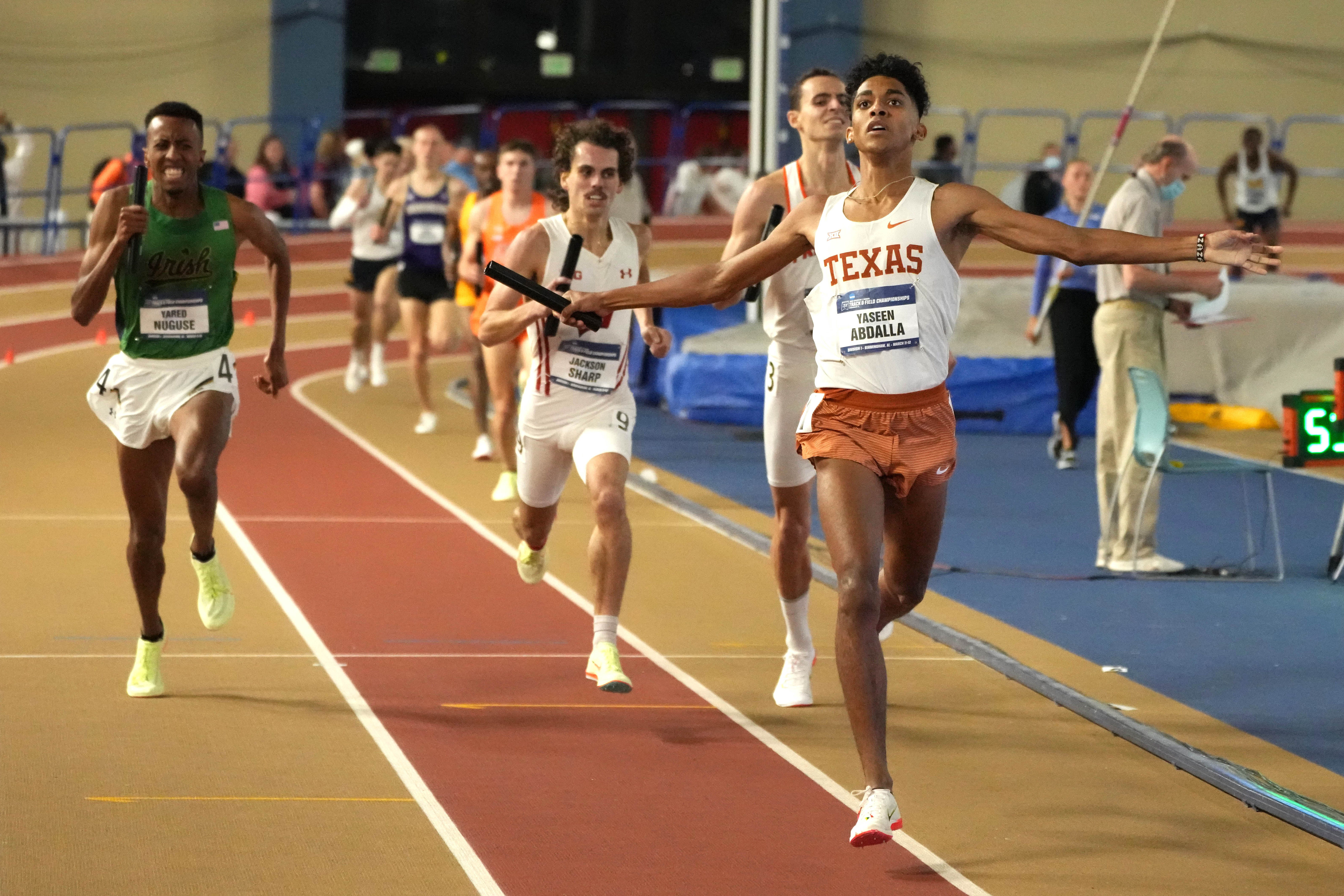
Texas’ only victory came when sophomore Cruz Gomez, junior Willington Wright, sophomore Crayton Carrozza and freshman Yaseen Abdalla won the distance medley relay.
However, junior Jonathan Jones and freshman Yusuf Bizimana finished second and fourth in the 800 for the Longhorns, and senior Jon Maas, Jones, Wright and freshman Brian Herron placed second in the 1,600 relay, as did senior Adrian Piperi in the shot put. In addition, sophomore Leo Nengebauer finished third in the heptathlon and Carrozza placed seventh in the mile.
Add Florida: Moore raised her collegiate record in the women’s triple jump to 47 feet 9¾ inches (14.57 meters) on her first attempt before bounding 46-7½ in the second round, and fouling her third attempt. She then passed in each of the final three rounds.
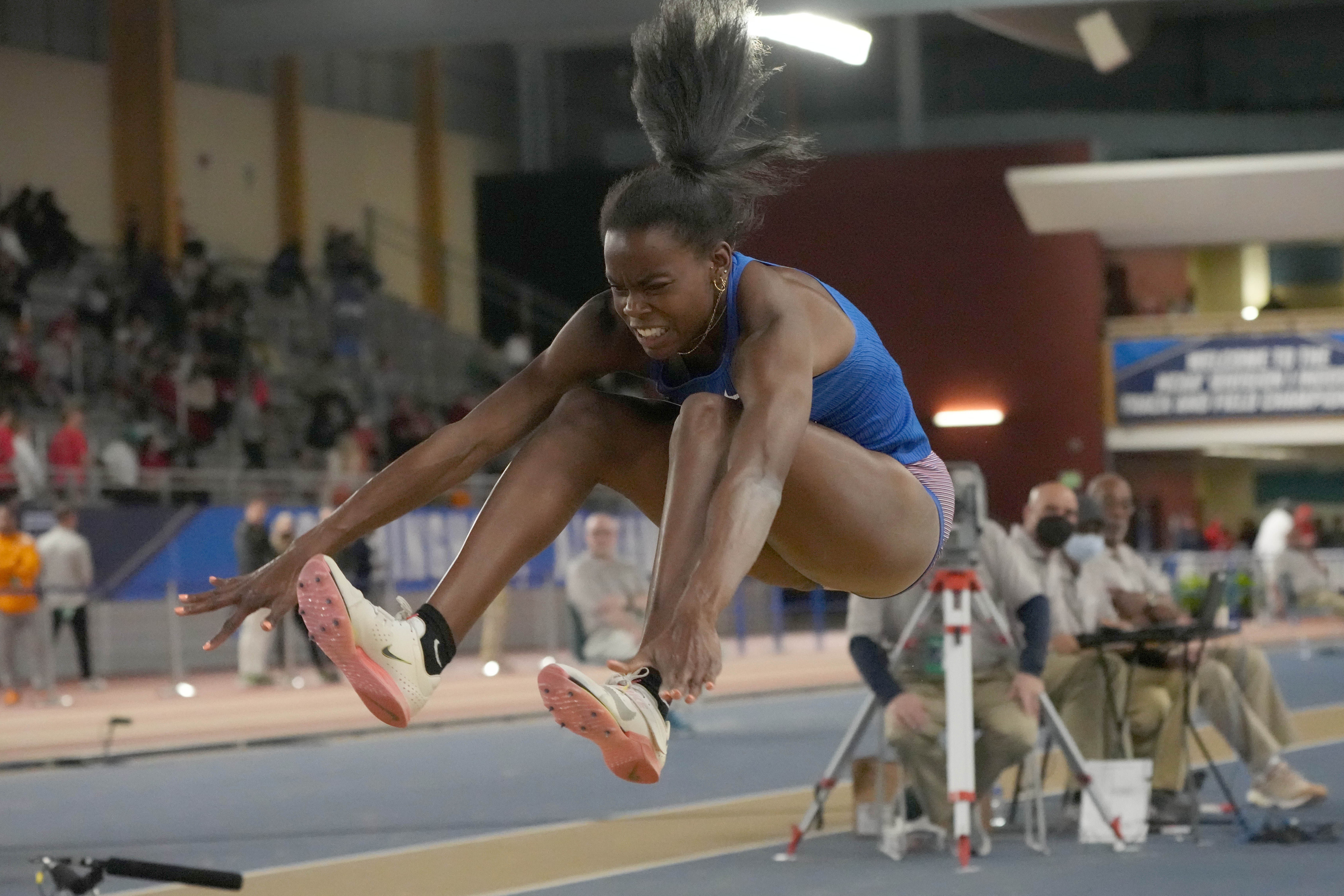
Stark tied the collegiate record in the women’s 60 hurdles with a 7.78 clocking that came 30 minutes after she had finished fourth in the 60 with a time of 7.13. Sophomore Alia Armstrong of LSU was expected to battle Stark for the hurdle title, but she was disqualified from the final for a false start.
The collegiate record was first set in 2013 by Brianna Rollins of Clemson, who later led the U.S. to a 1-2-3 finish in the 100 hurdles in the 2016 Olympic Games in Rio de Janeiro.
Distance power: Northern Arizona, winners of five of the past six Division I men’s cross-country titles, placed fourth in the indoor meet by tallying all 29 of its points in the 5,000 and 3,000.
Lumberjack sophomore Abdihamid Nur won the 5,000 in 13 minutes 19.01 on Friday and the 3,000 in 7:59.88 on Saturday. Freshman teammates Nico Young and Drew Bosley placed third and eighth in the 5,000, and Young placed seventh in the 3,000 in a tight race in which the gap between the winner and eighth-place finisher was just under a second.
Young’s 13:21.23 clocking in the 5,000 bettered his previous best of 13:22.59, which was a U.S. indoor junior (under 20) record when he ran it in December.
Climbing the list: Randolph Ross of North Carolina A&T ran the third fastest indoor 400 time in history when he clocked 44.62 in the NCAA meet.
The time bettered the junior’s previous best of 44.83 set last month, and moved him just ahead of Michael Johnson (44.63 from 1995) on the all-time world indoor list. The two men ahead of him are fellow Americans Michael Norman (44.52 from 2018) and Kerron Clement (44.57 from 2005).
Johnson’s exploits – only man to win the 200 and 400 in the same Olympic Games, only man to win consecutive Olympic titles in the 400, world-record holder in the 200 (19.32) and 400 (43.18) when he retired after the end of the 2001 season – are well known.
Norman, in addition to his indoor world record in the 400, is tied for fourth on the all-time outdoor performer list at 43.45, and won the U.S. Olympic Trials last summer before finishing fifth in the Olympics in Tokyo.
Clement is best known for his performances in the 400 intermediate hurdles as he won the 2016 Olympic title in Rio de Janeiro and placed second in the 2008 Games in Beijing. In addition, he won world titles in 2007 and ’09, placed third in 2017, and finished fourth in 2005 and ’15.
Superb finish: Abby Steiner of Kentucky capped a sensational indoor season by winning her second consecutive NCAA title in the women’s 200 in a meet-record 22.16, finishing second in the 60 in a career-best 7.10, and running the second leg on a Wildcat foursome that placed third in 3:28.77 in the 1,600 relay.
Paced by Steiner, a junior, Kentucky finished third in the team standings with 44 points.
Steiner’s time in the 200 was the second fastest of her career behind the 22.09 American and collegiate record she set in winning the Southeastern Conference meet 15 days earlier. That time ranks second on the all-time world list behind Jamaican Merlene Ottey’s 21.87 best from 1993.
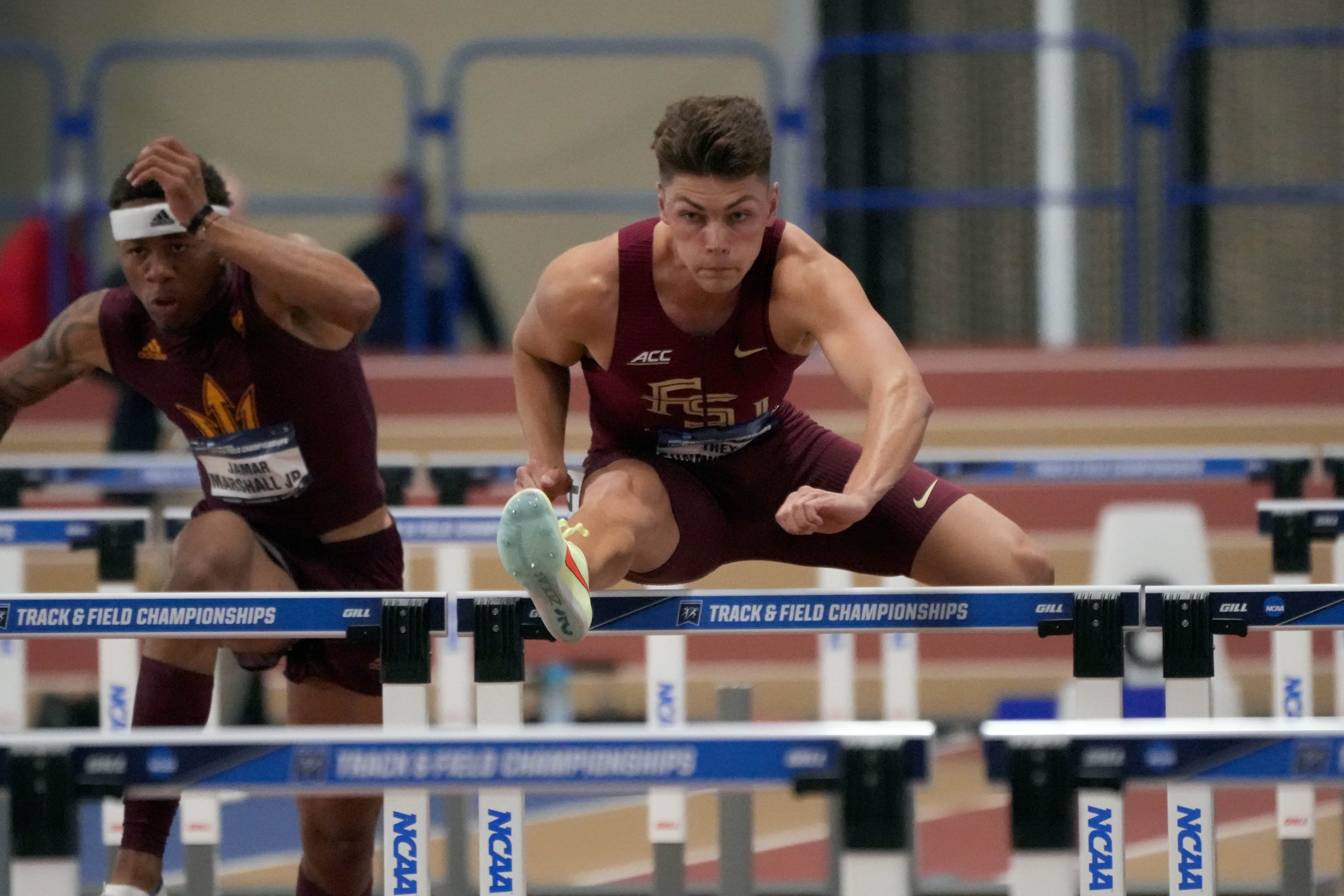
Runaway winner: Trey Cunningham of Florida State blasted the field in winning the men’s 60 high hurdles in the NCAA meet.
Cunningham, a senior, ran a career best of 7.38 to defeat runner-up and freshman Leonard Mustari of North Carolina A&T by .25 seconds. The time was the fourth fastest in the world this year – behind a trio of performances by fellow American Grant Holloway – and moved Cunningham into a three-way tie for 11th on the all-time world performer list.
Coming up short: Julien Alfred of Texas set a collegiate record of 7.04 in her qualifying heat of the women’s 60 on Friday, but finished fifth in 7.15 in the final on Saturday.
The Longhorn junior was among the top three sprinters through the first 25 meters of the final, but lost ground in the second half of the race won in 7.09 by sophomore Melissa Jefferson of Coastal Carolina.
Hard to defend: Only three out of nine athletes repeated their victories from 2021 in the NCAA meet.
In addition to Steiner winning the women’s 200 for the second year in a row, Emmanuel Ihemeje of Oregon bounded 55-2¾ (16.83) to win his second consecutive title in the men’s triple jump and Turner Washington of Arizona State successfully defended his title in the men’s shot put with a best of 71-0½ (21.65).
Record annihilation: Newbury Park High School in Southern California added to its legacy as the greatest boys’ distance program in U.S. history when it ran a national high school record of 16:29.31 to win the four-mile relay in the New Balance Nationals Indoor Meet at the Armory in New York City on Saturday.
The time lopped 31 and a half seconds off the previous best of 17:01.81 set by Loudoun Valley High of Purcellville, Virginia, in 2019.
Junior Aaron Sahlman ran 4:11.37 on the opening mile leg for Newbury Park, and he was followed by junior twins Leo and Lex Young, who ran 4:06.86 and 4:07.34, and senior – and older brother – Colin Sahlman, who ran 4:03.74.
Last, but far from least: Mondo Duplantis of Sweden got last week off to a rip-roaring start when he cleared an indoor world-record height of 20-3¾ (2.19) in the men’s pole vault in a meet in Belgrade, Serbia, on March 7.
It was the third world indoor record for Duplantis, who set previous marks of 20-2¾ (6.17) and 20-3¼ (6.18) in 2020.
Duplantis, 22, has set a combined four world records indoors and outdoors. In addition, he has cleared 20-0¼ (6.10) or higher in six meets during his career.
Sergey Bubka accomplished that feat a best-ever 11 times while competing for the Soviet Union during much of his career and then for his home country of Ukraine after the dissolution of the Soviet Union in 1991.
Frenchman Renaud Lavillenie is the only other vaulter to have cleared 6.10 and he has done it once indoors.